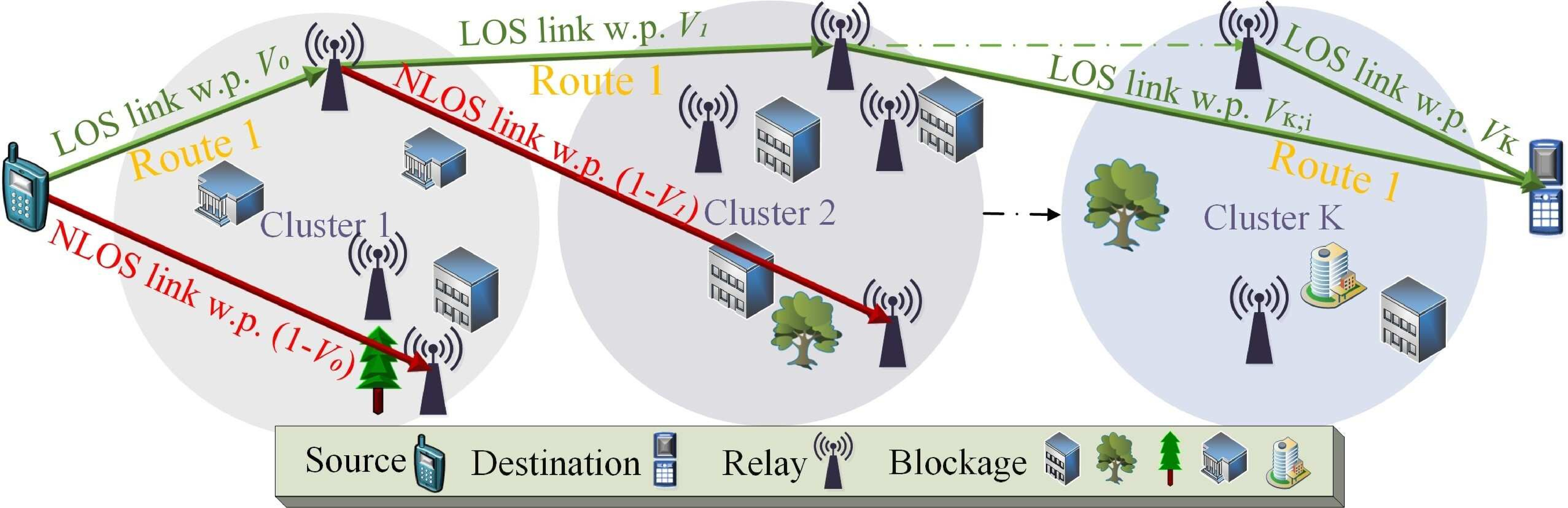
One of the most promising technologies for 6G is the use of millimeter waves (mmWaves) because these waves provide wide bandwidth and high data rates. However, these waves are highly sensitive to blockage and hence have short range. Thanks to the relay-aided multi-hop transmission, we can overcome this limitation and improve the range of mmWaves. In this paper, we investigate different types of relay selection schemes and routing for the cluster-based multi-hop (CBMH) mmWave network. These schemes are classified into bypass based and without bypass, where bypass refers to the direct links from the intermediate clusters to the destination. We analyze and simulate these schemes in terms of the blockage probability, the end-to-end (e2e) normalized energy consumption (NEC), the e2e average hop count (AHC) and the spectral efficiency. The analytical results and the simulations show that the bypass based relay selection schemes outperform their counterparts without bypass in terms of the blockage probability, the e2e AHC and the spectral efficiency. However, in terms of the e2e NEC, the situation is reversed. The simulation results also show that the proposed relay selection schemes perform very close to the benchmark in terms of the spectral efficiency.
Introduction
The explosive growth of mobile data traffic over the past few years has driven the demand for significantly higher capacity and data-rates in wireless communication networks. In general, previous generations of communication networks have used the microwaves (µWaves) band. However, these waves cannot meet this demand because of the bandwidth limitations in this range of frequencies. One of the promising technologies to solve this problem is the use of the millimeter wave (mmWave), whose frequency is in the range of 30 to 300 GHz. This technology provides Giga-Hertz bandwidth to the network and thanks to this wide range, it is possible to download an Ultra HD movie in less than a few seconds. These waves offer many merits for next-generation communications, including high bandwidth, high data rate, high security, re duced antenna size and weight, reduced interference, and spectrum reuse [1]. Because of the short wavelength of these waves (which is 1–10 mm), the mmWave communications suffer from certain limitations such as being prone to shadow ing, experiencing considerable attenuation especially at higher frequencies, and having limited penetration power. An im portant drawback is their susceptibility to obstructions, which restricts their effective range to short distances [1].
Buildings, trees, humans and vehicles are the main examples of static and dynamic obstacles. The significant influence of blockage on mmWave signal propagation introduces challenges for maintaining a reliable connection. Hence, the attainment of a line of sight (LOS) link is highly desirable for mmWave networks to ensure exceptional reliability [2], [3].
This article has been published in the prestigious journal IEEE Transactions on Communications (TCOM) in May 2025. DOI: 10.1109/TCOMM.2025.3571949. →...
Follow the link to Read more →...